Mastering Makeup Artistry: Global Certification Program

Share

About Course

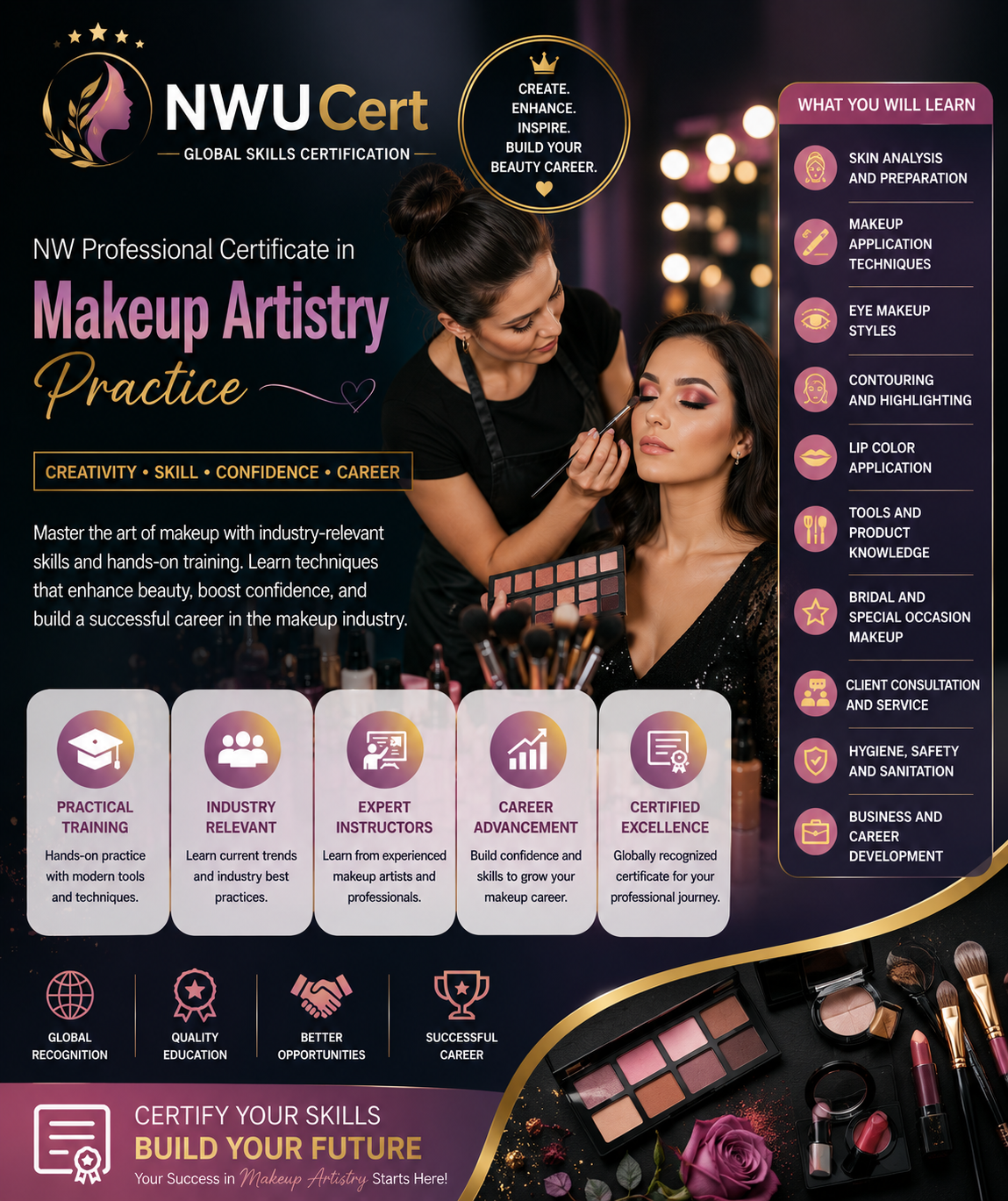
Unlock your potential and elevate your career with our “Mastering Makeup Artistry: Global Certification Program.” This comprehensive course is meticulously designed for aspiring makeup artists and beauty enthusiasts seeking to refine their skills and gain a competitive edge in the global beauty industry.

Course Overview:

Embark on an immersive journey through the multifaceted world of makeup artistry. This program covers everything from the fundamentals of makeup application to advanced techniques used by top professionals worldwide. You will explore diverse styles and trends, from classic beauty looks to avant-garde creations, all while learning to work with different skin tones and face shapes. Our curriculum is enriched with insights into the latest products and tools, ensuring you are at the cutting edge of beauty innovation.

Key Learning Outcomes:

  • Fundamental Techniques: Master the essential techniques of makeup application, including contouring, highlighting, and blending, to create flawless looks.
  • Advanced Skills: Develop expertise in specialized areas such as bridal makeup, theatrical effects, and editorial styles.
  • Global Trends: Gain an understanding of global beauty trends and cultural influences on makeup styles.
  • Professional Development: Learn about the business side of makeup artistry, including client communication, portfolio building, and branding.
  • Certification: Upon completion, receive a globally recognized certification that showcases your skills and enhances your professional credibility.

Target Audience:

This program is ideal for makeup artists at the beginning of their career who are eager to establish a strong foundation, as well as intermediate practitioners looking to expand their repertoire and advance their professional standing. Beauty enthusiasts with a passion for makeup and a desire to turn their hobby into a career will also find immense value in this course.

Join us in the “Mastering Makeup Artistry: Global Certification Program” and transform your passion for beauty into a rewarding career. Gain the skills, knowledge, and confidence to make your mark in the vibrant world of makeup artistry.

Certificate & Verification

Digital PDF Certificate, Online Verification and Physical Certificate Option

After successful completion and approval, candidates receive a digital PDF certificate. Certificate records may be checked through NWUCert online verification.

PDF Certificate

Digital certificate issued after successful completion, final review, and administrative approval.

Online Verification

Certificate ID can be checked through the official NWUCert verification page.

Physical Certificate

Printed certificate available for 120 USD, including international courier delivery to the applicant’s address.

Show More

What Will You Learn?

  • Understand the essential principles, terminology, and professional standards of Makeup Artistry: Global.
  • Apply safe, ethical, and quality-focused procedures in realistic workplace situations.
  • Identify the main tools, materials, service steps, documentation needs, and performance expectations.
  • Improve problem-solving, client communication, reporting, and supervisor-ready workplace behavior.
  • Prepare for NWUCert certification review through structured lessons, practical tasks, quizzes, and final assessment readiness.
  • Improve client consultation, hygiene control, service preparation, professional presentation, and aftercare communication.

Course Content

Introduction to Makeup Artistry: Foundations and Tools

  • History and Evolution of Makeup Artistry
  • Essential Makeup Tools and Their Uses
  • Makeup Tools and Their Applications Quiz
  • Basic Skin Types and Prepping Techniques
  • Create Your Personalized Makeup Kit

Skin Preparation and Base Makeup Techniques
<h2>Skin Preparation and Base Makeup Techniques</h2><p>This vocational lesson develops a professional, cosmetic workflow for preparing the skin surface and applying base makeup for different client needs, lighting conditions and finish preferences. It does not teach medical diagnosis or treatment, and it does not confer a government licence, statutory registration, permit, medical authority or authorization to perform regulated work.</p><h3>Learning outcomes</h3><ul><li>Prepare the client and workstation using hygienic cosmetic practice.</li><li>Assess observable cosmetic presentation without diagnosing a medical condition.</li><li>Select cleansing, moisturising, primer and base products for the intended cosmetic finish.</li><li>Apply thin, controlled layers and adjust coverage without unnecessary product build-up.</li><li>Recognise stop-and-refer boundaries when the skin presentation is outside cosmetic scope.</li><li>Document product choices and evaluate the final base under relevant lighting.</li></ul><h3>The BASE-CHECK workflow</h3><ol><li><strong>B — Brief:</strong> confirm desired finish, event, photography needs, sensitivities reported by the client and products already used.</li><li><strong>A — Assess cosmetically:</strong> observe surface dryness, shine, texture, visible flaking, redness, previous makeup and other non-diagnostic features.</li><li><strong>S — Sanitize and set up:</strong> prepare clean tools, disposables, palette and separated clean/used zones.</li><li><strong>E — Establish compatibility:</strong> choose preparation and base products that work together rather than layering incompatible textures.</li><li><strong>C — Cleanse appropriately:</strong> remove residue without overworking the skin.</li><li><strong>H — Hydrate strategically:</strong> apply moisturising product where needed and allow appropriate settling time.</li><li><strong>E — Even with thin layers:</strong> build foundation or complexion product gradually.</li><li><strong>C — Correct selectively:</strong> add localised coverage rather than increasing product everywhere.</li><li><strong>K — Check:</strong> inspect colour, texture, edges, wear points and finish in the lighting relevant to the client’s use.</li></ol><h3>1. Cosmetic observation, not medical diagnosis</h3><p>Makeup professionals work from what can be observed and from information the client voluntarily reports. Useful descriptions include visible shine, dry-looking areas, surface flaking, uneven cosmetic texture, previous product residue or a preference for a matte/dewy finish. Avoid diagnosing eczema, dermatitis, acne severity, infection or other medical conditions. If there is unexplained swelling, broken or weeping skin, signs of infection, severe irritation, a significant allergic reaction or another concern beyond cosmetic scope, stop the service and recommend appropriate professional medical advice.</p><h3>2. Hygiene and contamination control</h3><p>Decant creams and liquids onto a clean palette where appropriate instead of repeatedly touching the original container with used tools. Use clean brushes, sponges or single-use applicators according to the product and service. Keep clean tools separate from used tools. Do not double-dip a used applicator into a shared product. Clean and disinfect reusable tools according to their material and manufacturer guidance.</p><h3>3. Cleansing and surface preparation</h3><p>The purpose of cleansing is to remove surface residue that would interfere with the cosmetic application, not to perform a treatment. Use a product suitable for cosmetic preparation and the client’s reported sensitivities. Avoid aggressive rubbing. After cleansing, reassess the surface rather than automatically applying the same preparation routine to every client.</p><h3>4. Moisturising and timing</h3><p>Apply moisturising product according to visible need and desired finish. Too little preparation can leave base products catching on dry-looking texture; too much can reduce grip and increase movement. Allow the preparation to settle before deciding whether additional product is needed. The correct amount is determined by the surface response, not by a fixed number of pumps.</p><h3>5. Primer as a problem-solving layer</h3><p>Primer is optional and should have a clear purpose such as modifying finish, improving grip or smoothing the appearance of texture. Product compatibility matters. A primer and foundation that behave poorly together may pill, separate or form uneven patches. Test combinations during kit development rather than assuming all water-, silicone- or emollient-rich products will layer successfully.</p><h3>6. Shade and undertone matching</h3><p>Match complexion product to the area that gives the most useful transition between face and surrounding exposed skin. Check in neutral light where possible. Undertone describes the colour direction beneath the apparent depth of the skin; it should guide, not override, visual testing. A product that looks acceptable in the bottle can oxidise or shift after application, so allow a short observation period when testing unfamiliar formulas.</p><h3>7. Thin-layer base application</h3><p>Begin with a small amount and distribute from areas needing the most evening toward areas needing less. Use a clean brush, sponge or other suitable applicator. Keep pressure controlled. Thin layers are easier to correct, blend and set than one heavy layer. Build only where additional coverage is required.</p><h3>8. Selective correction</h3><p>Use concealer or additional base locally instead of increasing coverage over the entire face. This preserves dimension and reduces unnecessary product. Colour-correcting products should be used sparingly and blended so the correction does not create a new visible cast.</p><h3>9. Setting and finish control</h3><p>Powder or setting products should respond to the formula, skin presentation, climate, wear time and desired finish. Over-powdering can emphasise texture and make later adjustments difficult. Under-setting can allow movement in high-contact or high-shine areas. Check the finished base from normal conversational distance as well as close range.</p><h3>10. Lighting and camera checks</h3><p>Base makeup can behave differently under daylight, warm indoor lighting, flash and high-resolution photography. For event or media work, inspect transitions at the jaw, hairline and neck, and check whether texture or colour shifts are exaggerated by the relevant lighting. Do not rely on one mirror position alone.</p><h3>Worked case</h3><p>A client requests medium coverage for an evening event and reports that makeup often separates around the nose while looking dry on the cheeks. A strong workflow does not label a medical skin type. Instead, the artist observes the cosmetic presentation, uses light preparation on the areas that appear dry, avoids overloading the central face with emollient product, tests primer/base compatibility, applies foundation in thin layers and adds coverage selectively. The final result is checked in both neutral and event-style lighting.</p><h3>Applied activities</h3><ol><li><strong>Compatibility chart:</strong> test three preparation/base combinations on a practice surface or consenting model and record pilling, separation, grip and finish after settling.</li><li><strong>Coverage ladder:</strong> create sheer, medium and fuller cosmetic coverage using the same base product by controlling amount, placement and layering.</li><li><strong>Lighting audit:</strong> photograph the same finished base in daylight-equivalent light, warm indoor light and flash; record where colour or texture changes appear.</li></ol><h3>Error clinic</h3><ul><li><strong>Heavy first layer:</strong> creates thickness and makes correction harder. <strong>Better:</strong> build gradually.</li><li><strong>Automatic primer:</strong> adds an unnecessary layer that may conflict with the base. <strong>Better:</strong> use primer only for a defined purpose.</li><li><strong>Over-prepping:</strong> too much moisturiser can reduce grip. <strong>Better:</strong> reassess after each step.</li><li><strong>Diagnosis language:</strong> calling a visible feature a medical condition. <strong>Better:</strong> describe cosmetically and refer concerns beyond scope.</li><li><strong>Colour-only check:</strong> ignoring texture and wear behaviour. <strong>Better:</strong> assess shade, finish, edge transitions and stability.</li></ul><h3>Knowledge check</h3><ol><li><strong>Why should a makeup artist describe rather than diagnose the skin?</strong><p><strong>Answer:</strong> Cosmetic observation is within vocational makeup scope; medical diagnosis requires appropriately qualified healthcare practice.</p></li><li><strong>Why is decanting useful?</strong><p><strong>Answer:</strong> It reduces contamination risk by preventing used tools from repeatedly entering shared product containers.</p></li><li><strong>What is the purpose of a primer?</strong><p><strong>Answer:</strong> To solve a defined cosmetic problem such as grip, finish or appearance of texture; it is not automatically required.</p></li><li><strong>Why apply base in thin layers?</strong><p><strong>Answer:</strong> Thin layers are easier to blend, correct and build selectively without unnecessary heaviness.</p></li><li><strong>Why should unfamiliar foundation be allowed to settle during shade testing?</strong><p><strong>Answer:</strong> Some formulas can change colour or finish after application.</p></li><li><strong>What should you do with unexplained swelling or weeping skin?</strong><p><strong>Answer:</strong> Stop the cosmetic service and advise appropriate professional medical assessment.</p></li><li><strong>Why can too much moisturiser cause problems?</strong><p><strong>Answer:</strong> It can reduce product grip and contribute to movement or separation.</p></li><li><strong>Why check the jaw and neck?</strong><p><strong>Answer:</strong> They reveal whether the face base transitions naturally to surrounding exposed skin.</p></li><li><strong>What is selective correction?</strong><p><strong>Answer:</strong> Adding coverage only where it is needed rather than increasing product over the whole face.</p></li><li><strong>Why inspect under more than one light when relevant?</strong><p><strong>Answer:</strong> Colour, texture and reflectivity can appear different under daylight, indoor lighting and flash.</p></li></ol><h3>Practical evidence task</h3><p>Create a one-page base-preparation plan for a practice client. Include the client brief, observable cosmetic presentation, hygiene controls, chosen preparation products, compatibility rationale, shade-check method, application sequence, stop/referral boundaries and final quality checks. Add a short reflection identifying one adjustment you would make for longer wear, photography or a different finish preference.</p><p><strong>Credential boundary:</strong> This lesson supports professional/vocational makeup practice. Completion does not provide a government licence, statutory registration, permit, medical authority or authorization to practise a regulated profession.</p><p><em>Content enrichment marker: NWUCERT-MAKEUP-BASE-PREP-TECHNIQUES-ENRICHED-2026-09-21</em></p>

Advanced Eye Makeup and Creative Application

Specialized Looks: Bridal, Editorial, and Avant-Garde

Professional Portfolio Building and Career Development

Want to receive push notifications for all major on-site activities?

✕
Mastering Makeup Artistry: Global Certification Program 40 Hours · Online · Certificate Verification Available
Apply Now