About Course
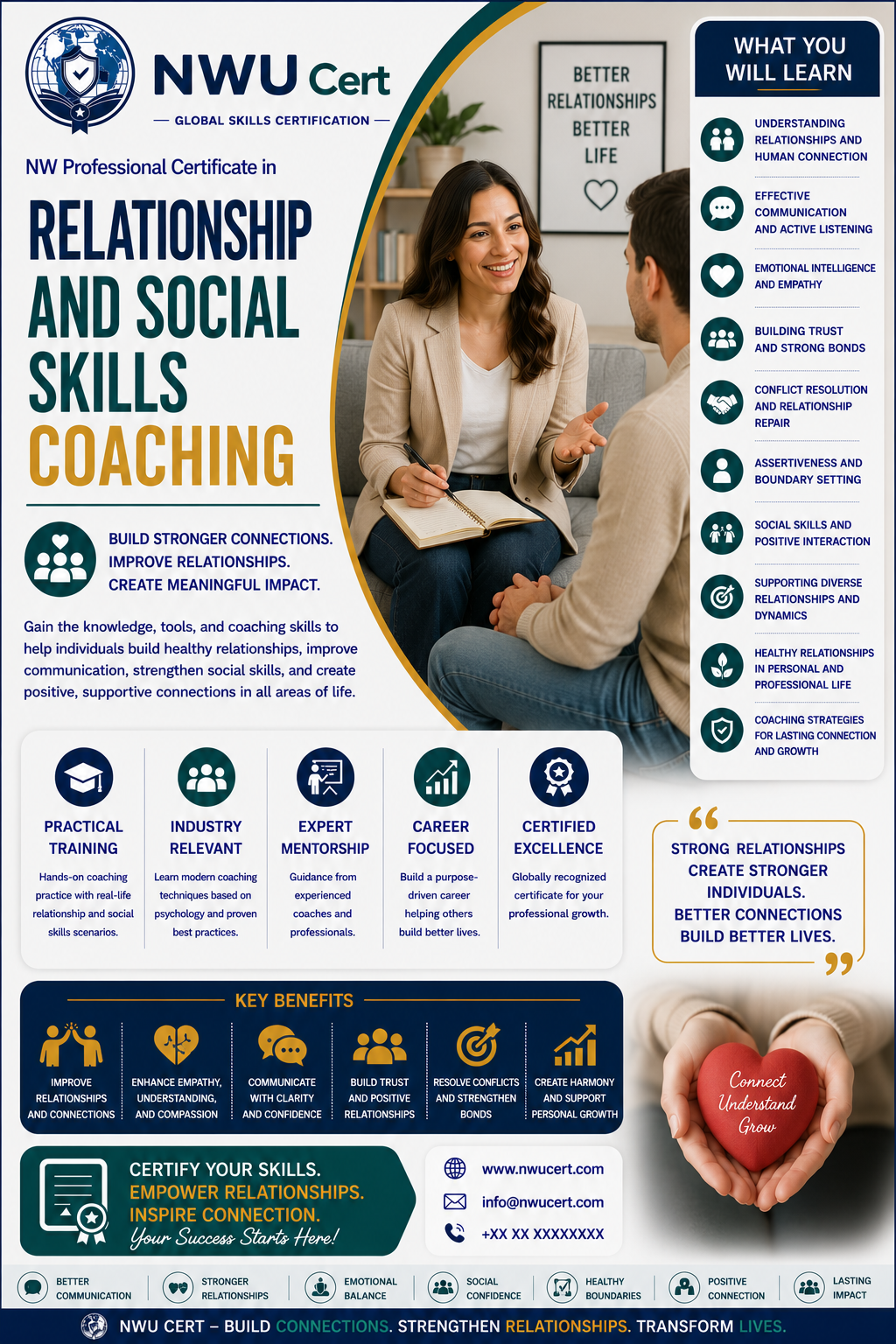
Unlock the power of effective communication and interpersonal dynamics with our “Mastering Relationship & Social Skills: Professional Coaching Certification” course. This comprehensive program is meticulously designed for individuals aspiring to become certified coaches, as well as professionals keen on enhancing their relationship-building capabilities in both personal and professional settings.
Course Overview:
This course delves into the core principles of relationship and social skills, equipping you with the tools needed to coach others towards healthier, more productive interactions. Through a blend of theoretical knowledge and practical application, you’ll explore key concepts such as emotional intelligence, active listening, conflict resolution, and the art of persuasion. Our expert instructors will guide you through interactive modules that include case studies, role-playing exercises, and real-world scenarios to ensure you gain hands-on experience in applying these skills effectively.
Key Learning Outcomes:
-
Emotional Intelligence Mastery: Understand and harness the power of emotional intelligence to foster empathy and strengthen connections.
-
Effective Communication Techniques: Develop advanced skills in active listening, non-verbal communication, and assertive speaking to enhance clarity and influence.
-
Conflict Resolution Strategies: Learn to navigate and mediate conflicts with confidence, turning potential challenges into opportunities for growth.
-
Building Trust and Rapport: Acquire techniques to quickly establish trust and rapport, essential for successful coaching relationships.
-
Coaching Methodologies: Gain insights into various coaching frameworks and methodologies that can be tailored to individual or group coaching sessions.
-
Professional Certification: Upon successful completion, receive a professional certification that validates your expertise in relationship and social skills coaching.
Target Audience:
This course is ideal for aspiring coaches, HR professionals, team leaders, managers, and anyone looking to enhance their interpersonal skills for career advancement or personal development. Whether you are just beginning your coaching journey or are an experienced professional seeking to refine your skills, this course will provide valuable insights and tools to elevate your capabilities.
Join us in mastering the art of relationship and social skills, and take a significant step towards becoming a certified professional coach. Empower yourself and others to build meaningful connections and achieve greater success in all areas of life.
Digital PDF Certificate, Online Verification and Physical Certificate Option
After successful completion and approval, candidates receive a digital PDF certificate. Certificate records may be checked through NWUCert online verification.
Digital certificate issued after successful completion, final review, and administrative approval.
Certificate ID can be checked through the official NWUCert verification page.
Printed certificate available for 120 USD, including international courier delivery to the applicant’s address.
What Will You Learn?
- Understand the essential principles, terminology, and professional standards of Relationship & Social Skills: Professional Coaching Certification.
- Apply safe, ethical, and quality-focused procedures in realistic workplace situations.
- Identify the main tools, materials, service steps, documentation needs, and performance expectations.
- Improve problem-solving, client communication, reporting, and supervisor-ready workplace behavior.
- Prepare for NWUCert certification review through structured lessons, practical tasks, quizzes, and final assessment readiness.
- Develop structured communication, goal-setting, ethical boundaries, reflective practice, and client-support confidence.
Course Content
Introduction to Relationship & Social Skills
-
Understanding the Basics of Relationships
-
The Role of Social Skills in Professional Success
-
Quiz: Assessing Your Understanding of Social Dynamics
-
Self-Assessment: Evaluating Your Current Social Skills
-
Building a Foundation: Trust and Communication
Foundations of Effective Communication
-
Introduction to Communication Theory
-
Active Listening Skills
-
Assessing Communication Styles
-
Personal Communication Reflection
-
Nonverbal Communication Cues
Advanced Techniques in Emotional Intelligence
<section class="nwucert-topic"><!-- NWUCERT-ADVANCED-EMOTIONAL-INTELLIGENCE-PROFESSIONAL --><h2>Advanced Techniques in Emotional Intelligence</h2><p>This lesson develops practical emotional-intelligence skills for professional communication, teamwork, coaching conversations and self-management. It is vocational education, not psychotherapy, clinical assessment or a government licence. Learners should use the techniques to improve workplace behaviour and refer clinical, safeguarding or regulated matters to appropriately qualified professionals.</p><h3>Learning Outcomes</h3><ul><li>Differentiate emotion recognition, emotional regulation, perspective-taking and relationship management.</li><li>Use observable evidence rather than assumptions when interpreting emotional cues.</li><li>Apply a structured method to difficult professional conversations.</li><li>Recognize common cognitive and interpersonal traps that reduce emotional accuracy.</li><li>Build a personal improvement plan using behaviour-based evidence.</li></ul><h3>The EI-PRO Framework</h3><ol><li><strong>E - Evidence:</strong> start with observable facts such as words used, timing, tone, missed commitments or changes in behaviour. Do not diagnose motives.</li><li><strong>I - Identify:</strong> name your own likely emotional state and the professional issue that needs attention. Use tentative language for other peoples emotions.</li><li><strong>P - Pause:</strong> create enough time to prevent an impulsive response. A pause can be a breath, a note-taking moment or a request to revisit the issue at a defined time.</li><li><strong>R - Reframe:</strong> convert blame into a solvable question. Replace “Why are you difficult?” with “What information or condition is preventing progress?”</li><li><strong>O - Outcome:</strong> agree on the next observable action, owner, deadline and follow-up point.</li></ol><h3>Technique 1 - Emotional Granularity</h3><p>Broad labels such as “bad,” “stressed” or “angry” often hide useful distinctions. In professional self-management, distinguish irritation from disappointment, urgency from anxiety, confusion from resistance and fatigue from disengagement. More precise self-labeling supports better response selection. This is not a clinical diagnosis; it is a vocabulary tool for workplace reflection.</p><h3>Technique 2 - Separate Signal from Story</h3><p>A signal is observable: a colleague interrupts repeatedly, replies later than usual or says a deadline is unrealistic. A story is the explanation we invent: “They do not respect me,” “They are lazy,” or “They want the project to fail.” Emotional intelligence improves when the signal is recorded first and the story is treated as a hypothesis that requires clarification.</p><h3>Technique 3 - Regulation Before Response</h3><p>Regulation does not mean suppressing emotion. It means selecting a response that serves the professional objective. Useful methods include delaying a non-urgent reply, writing a draft and reviewing it later, reducing message length, asking one clarifying question before defending a position, or moving a complex exchange from text to a scheduled conversation.</p><h3>Technique 4 - Perspective Testing</h3><p>Perspective-taking is stronger when it produces multiple plausible explanations rather than one confident guess. Ask: What information might the other person have? What constraint might I not see? What part of my message could reasonably be misunderstood? What alternative explanation would fit the same evidence? This reduces premature certainty.</p><h3>Technique 5 - Emotionally Intelligent Feedback</h3><p>Use a four-part sequence: <strong>Observation</strong> - describe the behaviour; <strong>Impact</strong> - explain the work consequence; <strong>Inquiry</strong> - ask for the other perspective; <strong>Agreement</strong> - define the next action. Example: “The last two handovers arrived after the agreed cutoff. That left the next shift without time to check them. What is creating the delay? Let us agree on a workable cutoff or escalation rule.”</p><h3>Technique 6 - De-escalation Without Avoidance</h3><p>When tension rises, reduce heat without abandoning the issue. Lower the pace, keep sentences short, acknowledge the legitimate part of the concern, avoid absolute language such as always and never, and return to the decision that must be made. If the conversation becomes unsafe, abusive or outside your role, stop and escalate through the appropriate organizational process.</p><h3>Technique 7 - Boundary-Aware Empathy</h3><p>Empathy in a professional setting means recognizing another persons perspective and responding respectfully; it does not require taking responsibility for solving personal or clinical problems. A useful boundary statement is: “I can help with the work issue and connect you with the right internal resource for the part outside my role.”</p><h3>Applied Case 1 - Defensive Reaction to Feedback</h3><p>A team member becomes defensive after receiving quality feedback. Instead of arguing about attitude, the manager returns to evidence: the specific work product, the required standard and the correction needed. The manager asks what was unclear, confirms the next deliverable and schedules a review. Emotional intelligence here supports clarity and dignity without lowering the standard.</p><h3>Applied Case 2 - High-Pressure Deadline</h3><p>Two colleagues disagree during a time-sensitive project. One interprets the other persons short messages as hostility. The team uses the signal-versus-story distinction: the signal is message brevity and rapid task requests; hostility is an interpretation. A quick check reveals time pressure rather than personal conflict. The team agrees to use explicit priority labels until the deadline passes.</p><h3>Applied Case 3 - Coaching Conversation</h3><p>A learner repeatedly misses self-imposed development goals. A vocational coach should not infer a mental-health condition. Instead, the coach explores observable barriers: unclear task size, competing commitments, missing resources, weak scheduling or unrealistic deadlines. The next plan is adjusted around those factors and progress is reviewed with evidence.</p><h3>Applied Case 4 - Cross-Cultural Misreading</h3><p>A colleague interprets limited eye contact as disengagement. The EI-PRO approach treats that conclusion as uncertain because nonverbal norms vary by culture, personality, accessibility needs and context. The colleague verifies understanding through questions and task follow-through rather than judging intent from a single cue.</p><h3>Professional Practice Activity</h3><p>Complete an Emotional Intelligence Decision Log for five workplace interactions. Record: observable signal; your first interpretation; your emotional state; at least two alternative explanations; the response you selected; the other persons actual response; and what you would repeat or change. The purpose is to improve calibration, not to label people.</p><h3>Question Bank with Answers and Explanations</h3><ol><li><strong>What is the safest starting point when interpreting another persons emotional state?</strong><br><em>Answer:</em> Observable evidence and tentative language.<br><em>Explanation:</em> Behaviour can be seen; motives and emotions are interpretations that may be wrong.</li><li><strong>What is emotional granularity?</strong><br><em>Answer:</em> Using more precise emotion labels instead of broad categories.<br><em>Explanation:</em> Precision can improve self-regulation and response choice.</li><li><strong>What is the difference between a signal and a story?</strong><br><em>Answer:</em> A signal is observable; a story is the explanation assigned to it.<br><em>Explanation:</em> Separating them reduces premature conclusions.</li><li><strong>Does regulation mean suppressing emotion?</strong><br><em>Answer:</em> No.<br><em>Explanation:</em> Regulation means choosing a response that supports the professional objective.</li><li><strong>Why generate multiple plausible explanations?</strong><br><em>Answer:</em> To reduce overconfidence in one interpretation.<br><em>Explanation:</em> The same behaviour may have several causes.</li><li><strong>What are the four parts of the feedback sequence used here?</strong><br><em>Answer:</em> Observation, Impact, Inquiry and Agreement.<br><em>Explanation:</em> The sequence keeps feedback evidence-based and action-oriented.</li><li><strong>What should happen when a conversation becomes unsafe or abusive?</strong><br><em>Answer:</em> Stop and use the appropriate organizational escalation process.<br><em>Explanation:</em> Emotional intelligence does not require remaining in an unsafe interaction.</li><li><strong>What is boundary-aware empathy?</strong><br><em>Answer:</em> Respectfully recognizing another perspective while staying within your professional role.<br><em>Explanation:</em> Empathy does not create clinical or other regulated authority.</li><li><strong>Why is one nonverbal cue insufficient to infer emotion?</strong><br><em>Answer:</em> Because culture, context, accessibility and individual differences affect nonverbal behaviour.<br><em>Explanation:</em> Use patterns and clarification rather than single-cue judgments.</li><li><strong>What evidence should an improvement plan track?</strong><br><em>Answer:</em> Observable behaviour, decisions, follow-through and outcomes.<br><em>Explanation:</em> Behaviour-based evidence is more useful than vague claims about personality.</li></ol><h3>Completion Standard</h3><p>A competent learner can apply emotional-intelligence techniques to professional situations, remain evidence-based, communicate respectfully, document improvement and recognize when an issue lies outside a vocational coaching or workplace-development role.</p></section>
-
The Neuroscience of Emotional Intelligence
-
Advanced Empathy Techniques
-
Case Study: Navigating Emotional Dynamics in Teams
-
Leveraging Emotional Intelligence for Leadership
Building and Maintaining Professional Relationships
<!-- NWUCERT-PROFESSIONAL-RELATIONSHIPS-PRACTICE --><section class='nwucert-enrichment'><h2>Building and Maintaining Professional Relationships</h2><p>Professional relationships are built through repeated evidence of reliability, respectful communication, appropriate boundaries and useful follow-through. They are not created by networking volume alone. In a vocational coaching and workplace-development context, the learner’s task is to understand how trust is formed, how expectations are clarified, how relationships are maintained over time and how strain can be repaired without overstepping professional scope.</p><h3>Learning Outcomes</h3><ul><li>Map professional relationships according to purpose, role, influence and communication need.</li><li>Set clear expectations about responsibilities, response times, confidentiality and boundaries.</li><li>Use consistent follow-through to build credibility.</li><li>Maintain relationships through proportionate contact rather than constant messaging.</li><li>Address misunderstandings with evidence, curiosity and a repair plan.</li><li>Recognize when a matter should be referred or escalated rather than personally resolved.</li></ul><h3>1. Relationship Quality Is Evidence-Based</h3><p>In professional settings, trust normally grows from patterns. A colleague remembers whether commitments were kept, whether information was handled carefully, whether credit was shared fairly and whether difficult issues were communicated early. Charisma can create a positive first impression, but sustainable relationships depend more heavily on predictable behavior.</p><h3>2. Four Foundations</h3><ol><li><strong>Reliability:</strong> doing what was agreed, or communicating promptly when circumstances change.</li><li><strong>Respect:</strong> recognizing role, time, expertise, dignity and legitimate differences in perspective.</li><li><strong>Clarity:</strong> making expectations, decisions, deadlines and boundaries visible rather than assumed.</li><li><strong>Reciprocity:</strong> contributing value without treating every interaction as an immediate transaction.</li></ol><h3>3. Stakeholder Mapping</h3><p>Not every professional relationship requires the same intensity. A useful map distinguishes: operational contacts needed for current work; decision-makers who approve or sponsor work; subject-matter experts who provide specialist input; peers who coordinate delivery; learners, clients or customers who receive service; and wider network contacts who may be relevant occasionally. The purpose of mapping is not manipulation. It is to communicate at the right level and avoid neglecting important relationships.</p><h3>4. The RELATION-PRO Framework</h3><ol><li><strong>R — Role:</strong> identify each person’s actual role and decision authority.</li><li><strong>E — Expectations:</strong> clarify outcomes, deadlines, communication channels and responsibilities.</li><li><strong>L — Listen:</strong> check priorities, constraints and concerns before proposing solutions.</li><li><strong>A — Act reliably:</strong> complete commitments and document important follow-up.</li><li><strong>T — Track:</strong> keep brief, appropriate notes on open actions rather than depending on memory.</li><li><strong>I — Inform:</strong> communicate material changes early and proportionately.</li><li><strong>O — Observe boundaries:</strong> protect confidentiality, avoid dependency and stay within the agreed professional role.</li><li><strong>N — Nurture:</strong> maintain useful contact through relevant updates, appreciation and reciprocal support.</li><li><strong>P — Problem-solve:</strong> address misunderstandings directly and factually.</li><li><strong>R — Repair:</strong> acknowledge an error, correct it and rebuild confidence through future behavior.</li><li><strong>O — Outcome review:</strong> periodically ask whether the relationship still has a clear purpose and healthy working pattern.</li></ol><h3>5. Expectation Setting</h3><p>Many relationship problems begin as expectation gaps. One person assumes a same-day reply; another assumes three days is acceptable. One thinks a conversation is confidential; another thinks it should be shared with the team. A strong professional practice is to make high-impact expectations explicit: who owns the next action, what completion looks like, when an update is due, which channel should be used and what information may be shared.</p><h3>6. Communication Cadence</h3><p>Maintenance does not mean frequent contact with everyone. High-dependency work may justify scheduled check-ins. Stable relationships may need only milestone updates. Dormant network contacts should not receive artificial messages merely to stay visible. A better rule is relevance: communicate when there is useful information, a genuine reason to reconnect, a commitment to honor or a relationship issue that should not be left to grow.</p><h3>7. Professional Boundaries</h3><p>Healthy relationships include limits. A coach, colleague or coordinator should not imply clinical, legal, financial or other regulated authority that they do not hold. Confidential information should not be used as social currency. Personal disclosure should be purposeful and proportionate. If another person’s needs move beyond the agreed service or role, the correct response may be referral, escalation or a clearer contract rather than deeper personal involvement.</p><h3>8. Relationship Repair</h3><p>When trust is damaged, vague reassurance is usually weaker than a concrete repair sequence. State what happened without defensiveness, identify the impact, correct the immediate issue where possible, clarify the new expectation and demonstrate reliability afterward. An apology matters most when it is connected to changed behavior.</p><h3>9. Workplace Cases</h3><p><strong>Case A — Missed Deadline:</strong> A colleague expected a report on Monday, but the learner realizes on Friday that completion will slip. Waiting until Monday morning damages trust. A better response is to communicate the risk immediately, explain what is complete, propose a realistic new date and identify any support required.</p><p><strong>Case B — Senior Contact Goes Silent:</strong> Repeated messages receive no answer. Escalating emotionally is unhelpful. Review whether the request is clear, whether the person is the right decision-maker, whether another approved channel exists and whether a concise deadline-based follow-up is appropriate.</p><p><strong>Case C — Confidential Information:</strong> A colleague shares sensitive personal information while discussing a workplace problem. Do not repeat it casually. Separate the operational issue from private details, follow organizational confidentiality rules and escalate only what is necessary through the appropriate channel.</p><p><strong>Case D — Relationship Strain After Feedback:</strong> A peer reacts defensively to feedback. Avoid diagnosing personality or motives. Return to observable behavior, the agreed standard and the shared work objective, then invite their perspective and agree a next action.</p><h3>10. Relationship Portfolio Activity</h3><p>Create a Professional Relationship Map with eight fictional or anonymized contacts. For each, record role, purpose, current level of dependency, preferred communication channel, one active expectation, one boundary and one next maintenance action. Then select two relationships and write a short repair or strengthening plan based on evidence rather than assumptions.</p><h3>11. Knowledge Check with Answers and Explanations</h3><ol><li><strong>What builds professional trust most reliably?</strong> Repeated evidence of dependable, respectful and appropriately transparent behavior.</li><li><strong>Why clarify expectations early?</strong> Because unspoken assumptions create avoidable conflict about timing, responsibility and communication.</li><li><strong>Should every network contact receive frequent messages?</strong> No. Contact should be relevant and proportionate to the relationship’s purpose.</li><li><strong>What is a professional boundary?</strong> A limit that protects role clarity, confidentiality, competence and appropriate responsibility.</li><li><strong>What should happen when a commitment will be missed?</strong> Communicate early, explain the status, propose a realistic recovery plan and follow through.</li><li><strong>Is reciprocity the same as keeping score?</strong> No. Reciprocity means a healthy pattern of mutual value, not demanding immediate repayment for every action.</li><li><strong>How should conflict be discussed?</strong> Start with observable facts, impact, agreed standards and a specific next step rather than assumptions about personality.</li><li><strong>When is escalation appropriate?</strong> When authority, risk, policy, safety, confidentiality or specialist expertise exceeds the learner’s role.</li><li><strong>What makes an apology credible?</strong> Recognition of impact, corrective action and consistent changed behavior.</li><li><strong>What is the purpose of a relationship map?</strong> To understand roles, communication needs, dependencies and boundaries so professional attention is allocated appropriately.</li></ol><h3>Applied Assignment</h3><p>Prepare a 600–900 word Professional Relationship Maintenance Plan for a fictional workplace project involving at least five stakeholders. Include role mapping, expectation setting, communication cadence, one confidentiality decision, one potential conflict, one escalation route and a repair strategy. Explain how each action supports trust without crossing professional boundaries.</p><p><strong>Certification boundary:</strong> This lesson forms part of professional and vocational education. Completion does not create government licensure, statutory professional status or authorization to practise psychotherapy, counselling, medicine, law, financial advice or another regulated profession.</p></section>
-
Understanding Professional Networking
-
Effective Communication in Professional Relationships
-
Identifying Key Networking Opportunities
-
Develop Your Networking Strategy
-
Managing Conflicts in Professional Relationships
Coaching Strategies for Social Skills Mastery
<section class='nwucert-lesson'><h2>Coaching Strategies for Social Skills Mastery</h2><p><strong>Course marker:</strong> NWUCERT-SOCIAL-SKILLS-COACHING-PRACTICE</p><p>This lesson presents non-clinical coaching methods for improving professional social skills through observation, deliberate practice, feedback and reflection. It is designed for vocational and workplace development. It does not authorize psychotherapy, counselling, diagnosis, treatment, mediation accreditation or any government-regulated professional practice.</p><h3>Learning Outcomes</h3><ul><li>Translate broad social-skill goals into observable workplace behaviours.</li><li>Use structured coaching conversations without diagnosing personality, mental-health conditions or motives.</li><li>Plan role-play and real-world practice with clear success criteria.</li><li>Give evidence-based feedback that separates observation from interpretation.</li><li>Track progress while respecting privacy, autonomy, cultural variation and professional boundaries.</li></ul><h3>1. What Social-Skills Coaching Is</h3><p>Professional social-skills coaching focuses on behaviours that can be observed and practised: opening a conversation, asking relevant questions, listening without interruption, summarizing, responding to disagreement, contributing in meetings, giving feedback, reading situational cues cautiously and closing an interaction clearly. Coaching is most useful when the target is specific enough to practise.</p><p>A weak goal is “be more charismatic.” A coach cannot reliably measure charisma, and the term can hide cultural or personality bias. A stronger goal is “in the next three team meetings, contribute one concise point, ask one clarifying question and summarize one agreed action.” The second version is observable, practiceable and reviewable.</p><h3>2. The COACH-SOC Method</h3><ol><li><strong>C — Clarify the situation:</strong> define the professional context, stakeholders and desired outcome.</li><li><strong>O — Observe behaviour:</strong> describe what was seen or heard without assigning motive. “You spoke for four minutes without pausing” is more useful than “you were self-centred.”</li><li><strong>A — Agree one target:</strong> choose a small behaviour that matters to the learner and fits the context.</li><li><strong>C — Create practice:</strong> rehearse the behaviour in a role-play, scripted scenario or planned workplace situation.</li><li><strong>H — Hear reflection:</strong> ask the learner what felt effective, difficult or unnatural before giving your own feedback.</li><li><strong>S — Specify feedback:</strong> connect feedback to examples and agreed criteria.</li><li><strong>O — Observe again:</strong> repeat the task under slightly different conditions to test transfer.</li><li><strong>C — Capture progress:</strong> record the practice, evidence, next step and any boundary or escalation issue.</li></ol><h3>3. Observation Before Interpretation</h3><p>Coaching quality improves when the coach distinguishes facts from stories about those facts. “The client looked away twice” is an observation. “The client was dishonest” is an interpretation and may be wrong. Eye contact, posture, silence, speaking speed and interpersonal distance vary by person, culture, disability, context and communication medium. No single nonverbal cue should be used as a diagnostic sign.</p><h3>4. Four Coaching Tools</h3><h4>Behavioural Baseline</h4><p>Before setting a target, observe or reconstruct a typical interaction. Record frequency, timing and context rather than assigning a personality label. For example: number of interruptions, unanswered questions, unclear action statements or missed summaries.</p><h4>Micro-skill Rehearsal</h4><p>Practise one component at a time. A learner who struggles with difficult conversations may first rehearse an opening sentence, then a clarifying question, then a summary. Smaller practice units reduce cognitive load and make feedback precise.</p><h4>Role-play with Reset</h4><p>Use a short scenario, stop at a decision point, discuss options, reset and repeat. The value comes from repetition with changed behaviour, not from performing a long theatrical scene.</p><h4>Transfer Plan</h4><p>Every practice should end with a real-world application: where, with whom, what behaviour, what evidence and when it will be reviewed. Practice without transfer can create confidence without workplace change.</p><h3>5. Feedback: SBI-R</h3><p>A practical feedback structure is <strong>Situation — Behaviour — Impact — Request</strong>. Example: “In today's project handover, when the engineer explained the delay, you summarized the issue before proposing a solution. That reduced confusion and helped the group agree on the next step. In the next meeting, keep the summary and add a confirmation question before moving on.”</p><p>The impact statement should be plausible and evidence-based. Avoid claims about hidden intention or psychological state. If impact is uncertain, say so: “The discussion became shorter after the summary” is safer than “Everyone finally trusted you.”</p><h3>6. Coaching Cases</h3><h4>Case A — The Quiet Contributor</h4><p>A competent employee rarely speaks in large meetings but contributes well one-to-one. The goal should not be to change personality. A useful coaching target might be to prepare one point in advance and deliver it during a defined agenda item. Success is participation that supports the role, not becoming highly extroverted.</p><h4>Case B — The Frequent Interrupter</h4><p>A supervisor often speaks before colleagues finish. The coach records the behaviour, agrees on a two-second pause and a summary-before-response rule, and practises it through short role-plays. Progress is tracked by fewer interruptions and clearer summaries, not by labels such as “aggressive personality.”</p><h4>Case C — Networking Follow-up</h4><p>A learner meets useful professional contacts but rarely follows up. The coaching plan uses a 24–48 hour follow-up template: reference the conversation, provide one relevant item or thanks, state a reasonable next step, and avoid repeated unsolicited messaging.</p><h4>Case D — Cross-Cultural Misreading</h4><p>A learner interprets limited eye contact as disengagement. Coaching reframes the issue: check understanding through questions and summaries rather than assuming meaning from one cue. This protects both accuracy and cultural respect.</p><h3>7. Boundaries and Escalation</h3><ul><li>Do not diagnose social anxiety, autism, personality disorders, trauma or other clinical conditions.</li><li>Do not pressure a learner to disclose medical, psychological or private personal information.</li><li>Do not promise that a communication technique will cure distress or resolve every conflict.</li><li>Do not coach someone to manipulate, deceive, intimidate or bypass consent.</li><li>If a situation involves harassment, safety, safeguarding, legal rights or serious mental-health concerns, use the organization's proper escalation or professional-support route.</li></ul><h3>8. Practice Activity — Social Skills Coaching Record</h3><p>Choose one professional interaction and complete a coaching record with these fields: context; desired outcome; observed behaviour; learner-selected target; practice scenario; success criterion; feedback example; transfer plan; review date; boundary or escalation note. Keep the record focused on professional development and only retain information necessary for the coaching purpose.</p><h3>9. Common Coaching Errors</h3><ul><li><strong>Too many goals:</strong> narrow the session to one or two behaviours.</li><li><strong>Personality labels:</strong> replace labels with observable actions and context.</li><li><strong>Advice before reflection:</strong> ask the learner to evaluate their own performance first.</li><li><strong>Generic praise:</strong> identify the specific behaviour that worked and why it was useful.</li><li><strong>No transfer step:</strong> connect rehearsal to a real situation and review point.</li><li><strong>Over-reading body language:</strong> use multiple sources of evidence and ask clarifying questions.</li></ul><h3>Knowledge Check — 10 Questions with Answers and Explanations</h3><ol><li><strong>What makes a coaching goal useful?</strong><br><em>Answer:</em> It describes a specific, observable behaviour in a defined context.<br><em>Explanation:</em> Observable goals can be practised and reviewed without relying on vague personality judgments.</li><li><strong>Why separate observation from interpretation?</strong><br><em>Answer:</em> Because an observed behaviour can have multiple explanations.<br><em>Explanation:</em> This reduces bias and prevents unsupported assumptions about motive or emotion.</li><li><strong>What is micro-skill rehearsal?</strong><br><em>Answer:</em> Practising one small component of a larger social task.<br><em>Explanation:</em> It allows focused repetition and precise feedback.</li><li><strong>What does the learner do before receiving coach feedback in COACH-SOC?</strong><br><em>Answer:</em> Reflect on what felt effective or difficult.<br><em>Explanation:</em> Self-evaluation improves ownership and reveals information the observer may not have.</li><li><strong>What is the purpose of role-play reset?</strong><br><em>Answer:</em> To repeat the same decision point using a different behaviour.<br><em>Explanation:</em> Improvement comes from deliberate repetition, not merely completing a scenario.</li><li><strong>Why is “be more charismatic” a weak target?</strong><br><em>Answer:</em> It is vague, culturally loaded and difficult to measure.<br><em>Explanation:</em> Coaching should target behaviours relevant to the role.</li><li><strong>Can one nonverbal cue prove a person's emotional state?</strong><br><em>Answer:</em> No.<br><em>Explanation:</em> Nonverbal behaviour varies by individual, culture, disability and context.</li><li><strong>What should a transfer plan contain?</strong><br><em>Answer:</em> The real situation, target behaviour, evidence and review point.<br><em>Explanation:</em> This connects rehearsal to workplace performance.</li><li><strong>When should coaching escalate rather than continue?</strong><br><em>Answer:</em> When the issue crosses into safety, safeguarding, legal rights, serious clinical concerns or another regulated domain.<br><em>Explanation:</em> Vocational coaching has professional boundaries.</li><li><strong>What is the best type of feedback?</strong><br><em>Answer:</em> Specific, evidence-based feedback tied to an agreed behaviour and outcome.<br><em>Explanation:</em> It gives the learner something concrete to repeat or adjust.</li></ol><h3>Applied Assignment</h3><p>Design a 30-minute non-clinical coaching session for a workplace social skill such as meeting participation, professional networking, active listening or handling disagreement. Include a behavioural baseline, one measurable target, a five-minute role-play, an SBI-R feedback example, a transfer plan and a boundary statement. Explain in 300–500 words why the plan remains vocational rather than clinical or licensed practice.</p></section>
-
Understanding Social Dynamics
-
Effective Communication Techniques
-
Social Skills Assessment
-
Role-Playing Social Scenarios
-
Building Rapport and Trust